


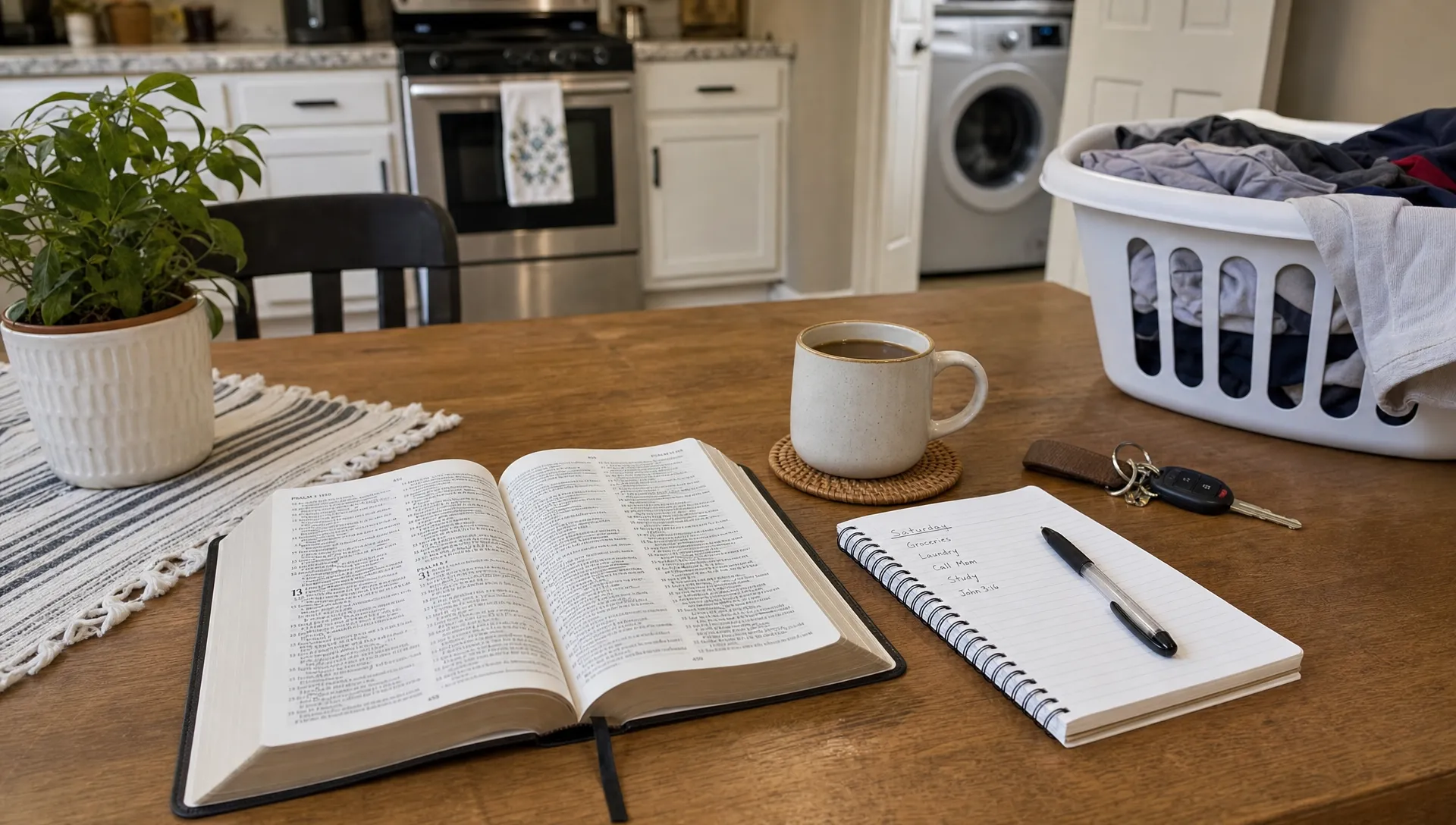
Most of the Christian life is not lived in dramatic moments. It is lived in kitchens, traffic, work messages, grocery lines, school pickups, quiet mornings and tired evenings. That is where living faith becomes more than a phrase. It is trust in Christ that moves with you into the next ordinary decision, giving shape to your words, your patience, your spending, your attention and your hope.
Scripture never treats faith as only private belief. Hebrews 11 shows men and women trusting God in real time, often without seeing the full outcome. James 2:17 reminds us that faith without works is dead. The point is not that we earn God’s love through activity. The point is that real trust becomes visible somewhere.
What Living Faith Looks Like in Ordinary Days
Faith is often easier to imagine in crisis than in routine. When something major happens, we know we need prayer, Scripture and the support of other believers. Ordinary days can feel less spiritual, but they may reveal what we truly believe with even greater honesty.
A person can sing about God’s sovereignty on Sunday and still live Monday as if everything depends on control. A believer can affirm God’s kindness and still treat inconvenience as an enemy. That is why daily faith is not measured only by emotion. It is seen in small acts of obedience when no one is applauding.
That daily yes is where living faith starts to take shape. It looks like telling the truth when exaggeration would benefit you. It looks like praying before reacting. It looks like forgiving again, giving generously, resisting bitterness and doing ordinary work as service to the Lord.
It Changes the Pace of Your Day
Many people begin the day already behind. Before their feet touch the floor, their minds are filled with tasks, notifications, worries and unresolved conversations. Faith does not magically remove responsibility, but it does reorder what gets first claim on the heart.
Living faith changes your pace because it invites you to receive the day before you try to manage it. Psalm 90:12 asks God to teach us to number our days so that we may gain a heart of wisdom. That prayer is not only for the end of life. It is for the beginning of a Tuesday.
A simple daily rhythm can help:
- Pause before checking your phone and acknowledge God’s presence.
- Offer one sentence of surrender, such as, “Lord, help me walk with You today.”
- Read or remember one passage of Scripture.
- Ask the Holy Spirit to shape your speech before your first conversation.
If you are learning to recognize God’s guidance in ordinary moments, this Kingdom Signals reflection on how to hear God’s voice in daily life can help you build a more attentive rhythm.
When routines feel insignificant
Repetition can make life feel small. Dishes return to the sink. Bills return to the inbox. People need patience again. Yet Scripture often shows God forming people in hidden places before anyone else sees the fruit. David watched sheep. Joseph served in places he did not choose. Jesus spent most of His earthly life in ordinary obscurity before His public ministry began.
Your hidden faithfulness matters to God. For encouragement on seeing His goodness in low-energy seasons, Kingdom Signals also has a devotional reminder that God is good even when you are tired.
It Changes How You Handle People
Ordinary days are filled with people who interrupt our plans. A child asks for attention when you are exhausted. A coworker misunderstands your tone. A spouse says something at the wrong time. A stranger drives aggressively. These are not interruptions to your spiritual life. They are often the place where it is tested.
In relationships, living faith refuses to separate love for God from love for neighbor. Jesus tied the greatest commandments together: love God and love your neighbor. The fruit of the Spirit in Galatians 5 is relational language, including love, patience, kindness, gentleness and self-control.
| Ordinary moment | Natural reflex | Faith-shaped response |
|---|---|---|
| Someone interrupts you | Irritation | Listen before defending your time |
| You are criticized | Self-protection | Receive what is true and release what is false |
| A family member is difficult | Withdrawal | Set wise boundaries without contempt |
| A coworker succeeds | Comparison | Practice gratitude and celebrate what is good |
| You feel overlooked | Resentment | Serve faithfully without making approval your reward |
Faith does not make you passive. It makes you responsive to God rather than ruled by impulse. You may still need hard conversations, boundaries and honest repentance, but you do not have to let every emotional wave become your master.
It Changes How You Carry Stress
Jesus did not shame anxious people. In Matthew 6, He addressed worry by pointing His listeners back to the Father’s care. Birds are fed. Flowers are clothed. Human beings, made in God’s image and loved by Him, are not forgotten.
Under pressure, living faith does not pretend stress is imaginary. It brings stress into communion with God. Prayer becomes more than a last resort. It becomes the place where burdens are named honestly and handed over repeatedly.
Philippians 4 connects prayer, thanksgiving and peace. That does not mean every problem disappears after one prayer. It means the believer is invited to stand inside the care of God while still facing real needs.
This matters because ordinary stress can quietly disciple us. If we constantly obey fear, fear trains our imagination. If we constantly rehearse worst-case scenarios, worry becomes familiar ground. Faith trains us to rehearse what is true: God is present, God is wise, God provides daily bread and God gives grace for the next step.
It Changes Your View of Time
We often want God to work quickly because waiting feels like wasted time. Yet Scripture rarely presents patience as a delay in spiritual life. Patience is part of spiritual life. Abraham waited. Joseph waited. Israel waited. The disciples waited in Jerusalem before Pentecost.
With time, living faith teaches you to stop treating today as merely the hallway to tomorrow. The ordinary day in front of you is not a meaningless gap between answered prayers. It is a place for worship, stewardship and formation.
This does not mean every season feels equally fruitful. Some days feel dry, repetitive or confusing. Still, God is not limited to visible progress. Roots grow where people cannot see them. Character forms in decisions that may never become stories anyone else hears.
If waiting is a major part of your current season, you may find help in this biblical reflection on why faith requires patience.
Small Practices That Train a Daily Response
A faithful life is not built only by big resolutions. It is built by repeated responses to God’s grace. The goal is not to make living faith feel complicated. The goal is to become more aware of Christ in the places you already live.
Try beginning with one or two practices rather than attempting a complete overhaul. Small faithfulness done consistently is often more fruitful than intense effort that disappears after a week.
- Pray before transitions, such as before work, before a meeting or before walking into your home.
- Keep one verse visible during the week and return to it when your mind drifts.
- Turn one routine task into worship by doing it with gratitude instead of resentment.
- Practice one hidden act of service without announcing it.
- End the day with honest review, thanking God for grace and confessing where you resisted Him.
These practices are not spiritual chores that force God closer. In Christ, God is already near. The practices help train your attention so you can respond to His nearness with trust.
When You Fail to Live by Faith
No believer practices daily faith perfectly. You will rush past prayer. You will speak too quickly. You will choose control, comparison or fear. The enemy uses failure to accuse, but the gospel invites confession and return.
When you stumble, living faith returns to Jesus instead of hiding from Him. First John 1:9 speaks of confession and forgiveness. Hebrews 4 presents Christ as the High Priest who invites us to come boldly for mercy and grace in time of need.
Repentance is not proof that your faith is fake. Often, it is proof that grace is still working in you. The question is not whether you had a flawless day. The question is whether you are learning to bring the whole day, including your weakness, back to God.
Frequently Asked Questions
What does living faith mean in daily life? It means trusting Christ in practical decisions, not only in beliefs or church settings. It shows up in obedience, patience, prayer, repentance, generosity and love for others.
Is ordinary work spiritually meaningful? Yes. Colossians 3:23 teaches believers to work heartily for the Lord. Ordinary work becomes meaningful when it is offered to God with integrity, humility and love.
How can I practice faith when I feel tired? Start small. Pray one honest sentence, remember one promise from Scripture and choose one faithful response in front of you. God is not asking for performance. He invites dependence.
Does struggling with anxiety mean I lack faith? No. Many faithful believers experience anxiety. Faith brings fear honestly to God, receives His care and takes the next obedient step instead of letting worry rule the heart.
Keep Walking With God in the Ordinary
Ordinary days are not spiritually empty. They are full of invitations to trust, obey, repent, receive grace and love the people God has placed near you.
If you want weekly biblical insight and devotional encouragement for everyday faith, visit Kingdom Signals and consider joining the newsletter. The Christian life is walked one day at a time, and God is present in this one.