


Searching for scripture about having faith in God often begins with something you cannot resolve: a diagnosis, a delayed answer, a decision with no obvious right choice. You want to trust God, but you also want to know what will happen. The Bible does not treat those desires as identical. Faith rests in who God is, even when the outcome remains hidden.
That distinction matters. A verse is not a prediction that your preferred future will arrive. Read in context, Scripture offers something sturdier: reasons to trust God, permission to speak honestly and wisdom for taking the next faithful step without pretending you can see the whole road.
What Biblical Faith Means When You Lack Clarity
Biblical faith is more than positive thinking. Its strength comes from its object, God Himself, rather than from how confidently you can picture a favorable outcome.
Romans 8:32 grounds Christian confidence in God’s gift of His Son. Later in the same chapter, Paul names hardship, persecution and danger without suggesting that believers have failed. His assurance is that these things cannot separate them from God’s love in Christ.
When you read scripture about having faith in God, begin with that foundation. God’s love is not something you must prove by having an easy life. Nor does trust require you to call a painful situation good.
Three distinctions help keep your reading grounded:
- A promise reveals what God commits to do. It does not automatically guarantee the outcome you want.
- A narrative describes particular people and events. Their circumstances are not always instructions for yours.
- Wisdom teaches faithful judgment. It should not be reduced to a formula for avoiding every difficulty.
The passages below address different kinds of uncertainty. Bible quotations use the King James Version (KJV), with explanations in contemporary language.
Six Bible Passages for an Unclear Season
Proverbs 3:5–6: Trust Without Making Your Understanding Ultimate
“Trust in the LORD with all thine heart; and lean not unto thine own understanding.” (Proverbs 3:5)
The following verse calls us to acknowledge God in all our ways and promises His direction. Together, these verses challenge self-sufficiency, not careful thinking.
Proverbs repeatedly values wisdom, instruction and counsel. “Lean not” therefore cannot mean “stop asking questions” or “ignore the facts.” It means your understanding is not the final authority over your life. You can investigate a situation thoroughly while recognizing that you do not know everything God knows.
This scripture about having faith in God is especially helpful when you keep replaying a decision, hoping enough analysis will eliminate every risk. Trust allows you to use the information available without demanding complete control.
Ask yourself: “Am I seeking wisdom, or am I insisting on certainty before I will act?” Sometimes the faithful next step is gathering more information. Sometimes it is acting responsibly with the information you already have.
Psalm 56:3–4: Fear Can Become the Occasion for Trust
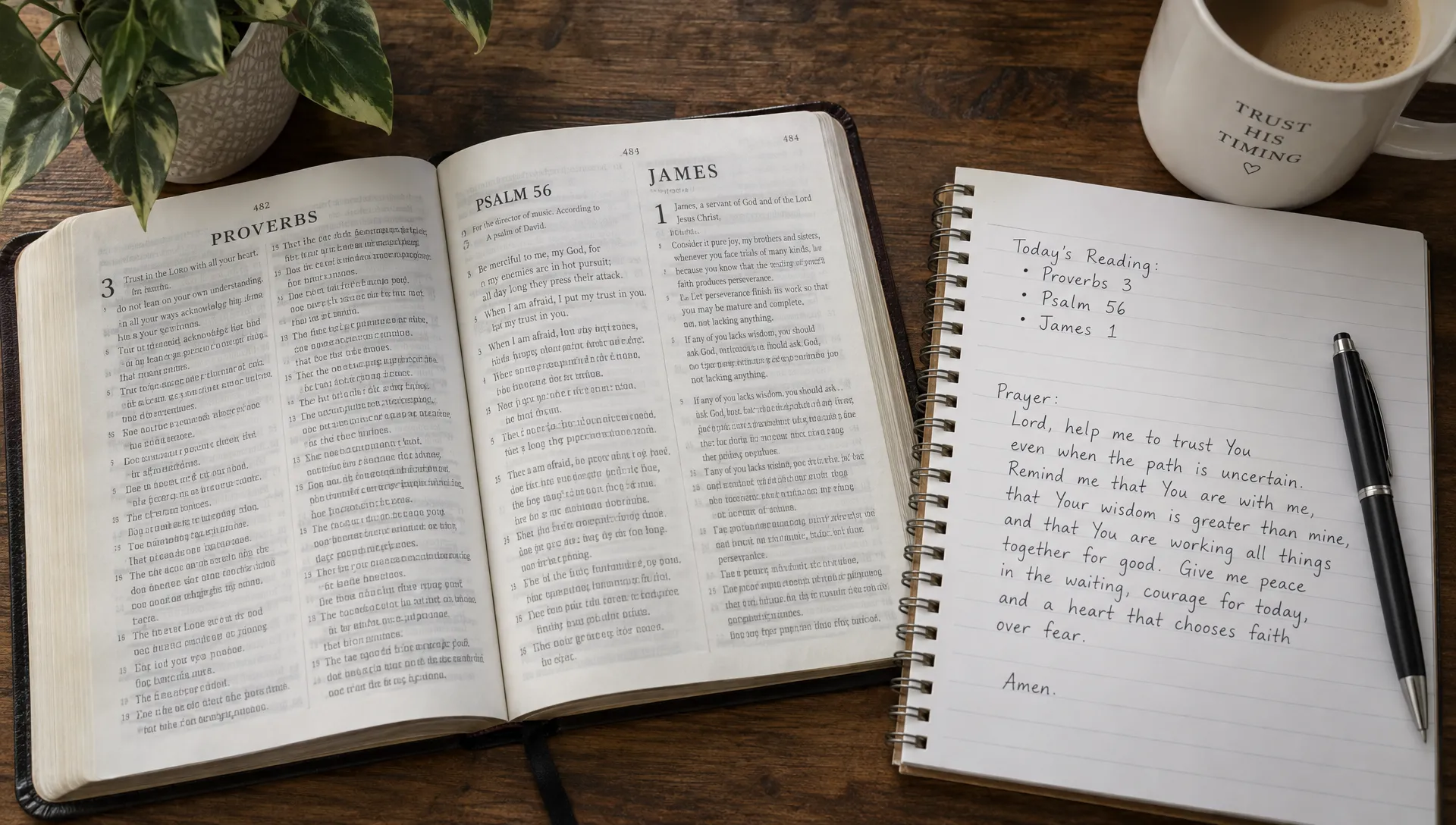
“What time I am afraid, I will trust in thee.” (Psalm 56:3)
David does not say that trust begins after fear disappears. He names fear and turns toward God within it. The surrounding psalm describes real threats, hostile words and distress. This is not confidence developed in comfortable circumstances.
Verse 4 connects trust with God’s word. David’s circumstances remain threatening, but they are no longer the only thing shaping his response.
That gives you a simple way to pray when uncertainty feels overwhelming: “God, I am afraid of this specific possibility. Help me remember what You have actually said.” Naming the fear keeps prayer honest. Returning to Scripture keeps fear from becoming your only source of interpretation.
If fear returns tomorrow, you have not invalidated today’s prayer. You can turn toward God again. Persistent anxiety also deserves appropriate care, including support from a counselor or healthcare professional when needed.
Mark 9:24: Bring Your Mixed Faith to Jesus
“Lord, I believe; help thou mine unbelief.” (Mark 9:24)
These words come from a father seeking help for his suffering son. His reply to Jesus holds belief and struggle together. He does not disguise his weakness or wait until his confidence feels complete before asking for help.
Here, scripture about having faith in God gives language to people who feel divided inside. You may believe God is good while struggling to imagine His goodness in your present circumstances. The father’s prayer shows how to bring that tension to Jesus rather than hiding it.
The account should not become a formula promising that every request will receive the same immediate outcome. Its invitation is to approach Christ honestly, including with faith that needs strengthening.
If you struggle to find words, learning how to pray Scripture with faith rather than fear can help you turn a biblical passage into a truthful conversation with God.
James 1:5: Ask for Wisdom, Not Just a Forecast
“If any of you lack wisdom, let him ask of God.” (James 1:5)
James gives this instruction in a discussion of trials and endurance. The need is not merely to know when difficulty will end, but to live faithfully while facing it.
This scripture about having faith in God redirects a common prayer. Alongside “Please show me what will happen,” you can pray, “Please help me respond wisely to what is happening.” Wisdom may concern a difficult conversation, a financial boundary or a responsibility you have been avoiding.
The following verses call for undivided trust in God. That is not a demand to manufacture an emotionally flawless prayer. It is a call to seek God sincerely rather than treating Him as one option while refusing His authority.
Look for the difference between what remains hidden and what is already clear. You may not know whether an opportunity will succeed, but you can still know that honesty, patience and care for others belong in your response.
Hebrews 11:8: Obedience Does Not Require a Complete Map
“He went out, not knowing whither he went.” (Hebrews 11:8)
Hebrews describes Abraham responding to God’s call without knowing his destination. His faith was not confidence in his own ability to predict the journey. It was trust in the God who called him.
But Abraham’s specific call does not mean every strong impulse you feel is a command from God. His story cannot justify reckless decisions or the claim that careful planning reveals unbelief.
Reading Hebrews 11 as a whole also guards against selective optimism. The chapter includes remarkable deliverance, but it also includes believers who suffered and people who died without receiving everything promised during their lifetimes.
Reading scripture about having faith in God means making room for both parts of that testimony. Faithfulness cannot be measured only by visible success.
For you, obedience may look less dramatic than Abraham’s departure: telling the truth, keeping a commitment or receiving help. You do not need a complete explanation of the future to honor a responsibility God has already made clear.
Habakkuk 3:17–19: Hope Is Deeper Than Favorable Conditions
“Yet I will rejoice in the LORD, I will joy in the God of my salvation.” (Habakkuk 3:18)
The preceding verse imagines agricultural devastation: no fruit, failed crops and empty livestock stalls. In that setting, these losses threaten survival. Habakkuk is not describing a minor inconvenience.
His “yet” does not erase the losses. It identifies a source of hope that those losses cannot exhaust. God remains the source of his salvation and strength even when familiar supports fail.
This passage does not require you to feel cheerful about grief, unemployment or disappointing news. Rejoicing in God can coexist with lament over what has happened. Habakkuk’s book itself contains searching questions and distress.
You might pray: “I do not welcome this loss. I cannot see how everything will work out. Yet I will turn to You for strength today.” That is different from pretending the circumstances are harmless. It places your hope in God rather than in circumstances becoming comfortable immediately.
Putting Scripture About Having Faith in God Into Practice
Choose the passage that best matches your present need, rather than trying to absorb every verse at once. Read its surrounding verses, name what it reveals about God and identify one response that fits the text.
Then separate trust from prediction. You can trust God’s character without claiming He has promised a particular job, relationship or purchase. You can also take practical action without treating action as a substitute for prayer.
Housing uncertainty offers an everyday example. A San Antonio reader considering manufactured housing might explore manufactured home options from Homes2Go San Antonio, then compare total costs, financing terms and location requirements before making a commitment. Prayer belongs alongside that research, not in place of it. A hopeful feeling alone does not establish that a purchase is affordable or wise.
For other decisions, the same principle applies: gather relevant facts, seek trustworthy counsel and consider your existing responsibilities. These Scriptures for decisions you need to make offer a useful companion when you need to connect biblical trust with a specific choice.
Frequently Asked Questions
What is a good Bible verse when I do not know what to do? James 1:5 is a helpful starting point because it invites you to ask God for wisdom. Read it alongside James 1:2–8 to see how that invitation relates to trials, endurance and sincere dependence on God.
Does feeling afraid mean I lack faith? Not necessarily. Psalm 56:3 explicitly brings fear and trust together. Scripture about having faith in God does not require denying your emotions. It invites you to turn toward God within them and seek appropriate support when fear is affecting daily life.
Does trusting God mean waiting without doing anything? No. Trust can involve preparation, counsel, responsible work and timely action. Sometimes waiting is necessary, but passivity is not automatically faithfulness. Ask what responsibilities are already clear, even if the final outcome is not.
What if I pray and still have no clarity? Continue asking for wisdom without assuming that silence means abandonment. Review what Scripture clearly teaches, seek mature counsel and distinguish a decision that must be made now from one that can wait. Avoid treating every coincidence or feeling as a guaranteed message from God.
Keep Returning to What God Has Revealed
You may finish today without knowing how your situation will unfold. Choose one passage, read it in context and let it shape one honest prayer and one faithful action. For ongoing biblical encouragement, visit Kingdom Signals to explore the free guide and subscribe to the weekly newsletter.